For my final project, I decided to present a piece similar to The New York Times’s innovative scroll kit story, Snow Fall. Please click the link below to view my project:

For my final project, I decided to present a piece similar to The New York Times’s innovative scroll kit story, Snow Fall. Please click the link below to view my project:
It’s easy to speak out against social media. It’s easy to say “you’re not actually communicating!” or “back in my day, we had actual conversations, not tweets.” It’s easy to fear change; it’s not as easy to fully understand the numerous benefits it can provide.
To start, it is clear that social media has significant influence in society:
Additionally, it’s clear that different social media sites are affecting us in different ways:


Teenagers report increased levels of confidence and decreased levels of shyness as a result of using social media.
It is apparent that social media has become significant in our lives; however, these sites have not become our lives. Studies have found that active users of social media are also proportionately social offline, displaying that many people are able to see social media as an extension of face-to-face communication, rather than a replacement for it. Additionally, data conducted by Common Sense Media provides that teenagers have reported increased emotional well being and strengthened friendships through the use of social media.
Teenagers report that social media has helped maintain and develop new friendships.
But this positive effect isn’t specific to teenagers; children are developing socially and exploring their own individuality through social media as well:
Though I surely can’t speak for everyone, social media has had a significant impact on maintaining my own relationships, especially since coming to college. Moving a few hours away from my hometown and knowing nobody in Ann Arbor definitely put my preexisting friendships to the test; social media allows me to connect with friends from high school every day and, therefore, remain close with these individuals. Though it may be something so seemingly meaningless as a Snapchat “hi” or a mention in a tweet, these small greetings let others know that I am thinking about them, and that I still care about our friendship. Additionally, social media allowed me to obtain and develop new friendships in Ann Arbor; Facebook groups within Michigan allowed me to meet new people (including my roommate), and Facebook events allowed me to coordinate and promote events for my student organizations and well as to find out about social gatherings on campus.

Some of the skills we gain from using social media, including media literacy and maintaining personal relationships.
Whenever new technology is introduced, people are often extremely skeptical and quick to claim that it’s “ruining us.” In the late nineteenth century, critics claimed that automobiles were dangerous and unnecessary. Forty years ago, skeptics denounced the first cell phone, a gadget many of us couldn’t imagine going without. Today, some people claim that social media is making us socially awkward; but these individuals are neglecting to recognize that, as with everything, our communication styles are bound to undergo change. We can’t rely on enveloped-letters to last forever, and we can’t expect chats over tea to be a practical option for today’s increasingly long-distance relationships. In time, skeptics of social media will understand this, and they will realize that they were simply afraid of a change.
I have always thought of Good Morning America as the quintessential morning “news” show. It’s the background of various morning routines, perfectly supplementing the sizzle of bacon on the stove and the aroma of stale coffee in the air. My house was more of a Today family, so I don’t know if I’d ever sat down and actually watched a whole Good Morning America episode before. (I can check that one off my bucket list now.)

I watched the Nov. 11 episode – though this was a week ago, it was the most recent episode available online for free.
The show is organized in such a way that one can watch it without really watching it, whether they are sitting in an office waiting room or getting ready for work at the same time. It is broken into segments, some of which included: a “BREAKING” weather broadcast on “freezing cold,” (3:55); a Navy S.E.A.L. who revealing “insider information” (2:12); a giant sinkhole in a Tampa neighborhood, complete with animation (3:45); new information on Joan Rivers’s death (4:01); a feel-good miracle mom” story of a woman who’s heart stopped beating during childbirth (4:30), a “Survival Week” segment with a reporter among sharks (complete with hashtag, #GMASurvivalWeek) (7:20); a visit from Taylor Swift (7:49); various Veteran’s Day-related stories (5:10); a discussion about Calvin Klein’s controversial “plus size” model (4:13); and a performance from Fitz and the Tantrums (5:47).

The visual aid animation for a story about a sinkhole in a tamps neighborhood.
Some stories were presented in more of a nightly news-type format, with an ABC correspondent reporting from a newsroom. These were the more hard-hitting topics, such as the Navy S.E.A.L. revealing information. Others, mainly feel-good stories such as the “miracle mom,” were casually discussed in the studio among the show’s iconic hosts. This conversational tone makes viewers feel like they’re part of a friendly talk with friends, rather than watching the news. (I’m not sure if this is a good thing.)

The Taylor Swift visit was presented with a conversational tone.
Personally, I found the subject matter interesting–a little too interesting. Most of the stories were either sensationalized “news” or irrelevant features. I feel like sometimes the news you should know isn’t going to be as interesting as a correspondent in a shark cage or Joan Rivers. Something else that is interesting to note was the scrolling news at the bottom of the screen, seemingly added to make the broadcast seem extra important. However, when I actually read it, the stories were not pressing at all, such as this one:

It seems like the show’s creators try to keep the target audience as broad as possible, hoping to not turn away any viewers to one of the few network morning broadcasts. Still, to me, it seems like the audience here is middle-aged viewers, possibly less-educated, who are watching simply “because it’s on.”

The sensational Survival Week shark story, complete with shark suits and waterproof cameras. (It was all quite exciting.)
Overall, the nature of Good Morning America’s content seems to follow the trend of hyper-sensational, feature-esque television news. Competing with intriguing dramas and reality shows, it’s no surprise that television news is trying to make itself more exciting to draw in viewers. Still, after watching, I didn’t feel like I learned anything new that I really needed to know, leading me to wonder; are these television broadcasts news, or just background noise?
The Opinion Page of a student newspaper is one of a college student’s main platforms for change. Whether the issue is University-wide or a national event, Editorial Pages allow the average student’s voice to be heard. I had the opportunity to interview Megan McDonald, one of the Co-Editorial Page Editors at the University of Michigan’s student newspaper, The Michigan Daily. She discussed how digitization is affecting the publication in terms of editorial decisions and publicity.
Overall, according to Megan, it is apparent that The Michigan Daily is taking action to maintain a steady online presence, as many of its readers are accessing the publication online. Since college students tend to be well-versed in new digital technology, from iPhones to laptops to tablets, this adaptation to different forms of display is necessary for survival. Megan mentions how story sharing on social media is critical to the spread of news for the Daily, specifically citing specific stories such as the Brendan Gibbons sexual misconduct case that caught national attention last spring, with online sharing largely contributing to the expansion.
With all of the digital publication of student newspapers and their utilization of social media sharing, one begins to wonder: what does this mean for student activism? With an increased audience as a result of the internet, student publications can expand beyond those who are able to pick up a physical newspaper on campus. In this way, stories are more likely to generate state-wide and national attention, allowing a student’s voice to resonate louder than ever before. Specifically, at the Daily, this means a wider audience for student-submitted pieces, including topics of divestment, sexual assault and campus diversity. The comments at the bottom of Editorial Page articles alone display the reach the internet provides, as many contributors are from colleges and universities across campus and vary in age. The comment function also provides an additional platform for discussion, dialogue and debate within the publication.
It is interesting to consider how a student’s Opinion piece may have been received before digitization. Likely, a student’s article was simply published on physical editions of the newspaper and received by those who happened to pick up a copy, open up to the Editorials and read it. Now, everything has changed: any student who opens their Facebook or Twitter accounts is likely to encounter a direct link to a student Opinion article on a regular basis. Here, students are immediately entered into the conversation, commenting and sharing their way toward social change.
AR: Can you describe your role at The Michigan Daily?
MM: Sure, I am the Co-Editorial Page Editor, and basically that means I run the Opinion Page, I oversee content that gets put through, edit content, hire writers, that kind of stuff. And that’s exclusively for the Opinion Page.
AR: How does technology and the internet, that sort of thing, shape editorial decisions that you all make at the Daily?
MM: Editorial-wise, a lot of our ideas come from stories that we see in other publications. Things that are happening on campus. Usually they are things that we find on the internet, so, a lot of ideas come from the internet.
AR: What is The Michigan Daily doing to draw an online audience and presence?
MM: So we have a social media chair that works with a team to use Facebook, Twitter, a bunch of different applications to kind of advertise and reach out to other readers, as well as making sure that we have a bigger online presence. We’re establishing a new website which will highlight our blogs more, make it easier for people to use on different devices. It’s more user-friendly.
AR: And you say ‘reach out to new readers. I’d imagine a lot of your readers are university students who are very active online. What specific steps do you think the Daily takes to cater to the increasingly digital students?
MM: I think a lot of it is the website ideas of trying to make it more usable on different devices. So like making sure that the website is accessible through tablets or iPhones, because a lot of people actually use mobile devices to read stories, is what our online editor has found. So kind of catering to that, I guess, kind of usage is the best way to do it. As far as reaching out to other audiences that are not university students, a lot of it is passed through Facebook. We’ve seen a lot of sharing links and then it gets passed on to someone who is maybe an alumni, who may be outside the university, who has friends at Michigan State, so it kind of makes its way around that way.
AR: Can you share a rough distribution of what your readership is in print versus on online forms, if you know that?
MM: I don’t really know the specific numbers, but I can definitely tell you that we have a really strong online presence, just because I believe our big story this semester was the Dave Brandon and Brady Hoke firing, and that was a lot of media tension just in general. We got on The New York Times for the stories. And then our biggest online presence was definitely the Brendan Gibbons case last semester, where we actually hit about 100,000 hits.
AR: That’s very impressive. Is there anything else you;d like to share?
MM: Um, no I think you covered it all.
AR: Thank you, Megan.
In early September, a Columbia University student and sexual assault survivor Emma Sulkowicz began a unique protest to bring administrative attention to campus rape culture and to spread awareness. The survivor is carrying a mattress everywhere she goes across campus as long as her accused rapist is not expelled. After Sulkowicz’s call to “carry that weight together” on October 29, students at Universities across the country raised awareness for sexual assault by marching across campuses with mattresses in tow. Here at the University of Michigan, students congregated at the Diag to protest the current sexual assault policy and to #CarryThatWeight.

Students begin to circle the Diag with a symbolic mattress.

The steps of the Hatcher Graduate Library are chalked with sexual assault statistics and the bold lettering, “RAPE HAPPENS.”

Students stand in solidarity with survivors.

Demands for reform of the University’s sexual assault policy are displayed on posterboard on the ground, symbolically covering the Diag’s iconic block “M.”

Mattresses display the hashtag “CarryThatWeight” to spread awareness digitally.

The scene at the Diag begins to generate attention, and becomes a space for dialogue and conversation.

A banner hung outside Mason Hall reads, “EXPEL RAPISTS.”

Messages on the ground reference the Columbia rape case as well as recent events at U of M that have brought skepticism to the sexual assault policy.

More students join the protest, chanting and marching for awareness.

At the end of the protest, student activists leave the Diag whilst proclaiming their message to the community.
 Internet access is often taken for granted. In areas that lack this connection, inaccessibility of Internet leads to issues including an education divide, a lack of communication outside a specific geographic area and even the inability to foresee natural disasters. So, BRCK was developed.
BRCK (named after its brick-like appearance) utilizes a cloud-based system to provide an Internet hub, useful in both overly-populated and rural areas where Internet connection is difficult or completely unavailable. Technologically speaking, the product utilizes a 3G SIM card that is data-enabled to access the Internet, which is available in over 140 countries (if in an area without SIM, BRCK has its own built-in). The product can also supposedly outlast blackouts and power surges, making it particularly useful in remote wildlife preserves.
The product was designed by an innovation team in Nairobi, Kenya, led by co-founder and CEO Erik Hersman. Hersman stated that the team developed the product because they “recognized a need for Internet in areas with poor infrastructure.”
To me, the most surprising element of BRCK is its price. One unit (which can connect up to 20 devices and provides 4 GB of storage) retails at $199, making the product reasonably affordable for those who need it most.

BRCK utilized in a Kenyan school.
Ultimately, the freedom and access BRCK provides is mind-boggling. The product has been very useful in remote African schools, providing students with the ability to utilize tablets and computers for learning. Not only does this make it easier for students to prepare for standardized exams and learn through technological devices, but–perhaps more importantly–it provides them with critical experience working with technology that will aid them in future careers. Transitively, by providing the connection, BRCK is giving rural African students a window to the world outside their village, a view of the future.
With the launch of the gender equality campaign HeForShe, people are wondering: who considers themselves feminists? This infographic from Maclean’s utilizes data from a 2014 YouGov/Economist survey to illustrate the answer.
 First, the graphic includes circles to show how many men considered themselves feminists before and after hearing the definition. I am glad that the study’s definition of “feminist” was included in the infographic, since this holds great potential for ambiguity.
Next, side-by-side horizontal bar graphs display the percentage of men and women who “very much” identified as feminists, sorted by country. I liked seeing how statistics varied across the globe and was surprised that (with 16% of men identifying as feminist), the United States was comparatively higher than others. Still, one criticism is that there is possibly too much information, with gender, country, and percent identification compared all at once.
Lastly, circles again display what respondents of all genders thought of the term “feminist.” Unsurprising to me, most people (a cumulative 37%) thought of the term negatively. Because there are varying degrees of strength for this section, I think the circles are more relevant here than in the first section, as smaller and larger circles are grouped to form broader definitions.
A general shortcoming would be that the title is slightly misleading. By using “Men…” it implies that the graphs utilize data gathered solely from men when, in actuality, men and women are sometimes compiled together.
Overall, the infographic stands apart from traditional journalism because it is more comprehendible to the common reader. If given these same statistics in paragraph form, I may not make the effort to think about the data comparatively. Here, the graphic’s inviting and clear design not only draws readers to the article but also helps them interpret a great deal of information.
Sure, social media is a great way to waste some time; but how can it help us create social change? University of Michigan senior and social activist Simon Rivers talks about his experience with utilizing digital media and up-to-date technology for social movements on campus, specifically the #BBUM (Being Black at the University of Michigan) movement.

The app’s design is simple and minimalist.
As a self-proclaimed late-adopter, it’s no surprise that I had never heard of NPR One. When I went to the App Store to download the application, I was notified that I would have to upgrade to an operating system of iOS 7 or later to run the program. Being a lover of iOS 6 who is generally fearful of change, I was hesitant. Still, I faced my fears and upgraded to get the app because, as we’ve been told in class, we live in an increasingly digital world and I’ve gotta keep up.

How I used to access NPR on my phone back in the olden days
After the process of upgrading and bringing myself out of 2012, I dove into NPR One. Immediately, I appreciated the minimalist layout of the app; the design was clear and I knew this would be reflected in its functionality.
Before I knew this app existed, I listened to NPR stories by accessing the NPR website through Safari on my iPhone. This method worked for me, and I liked how I was able to continue listening to a story even when I closed the tab on my device; still, I hadn’t considered that there could be a much easier way. Now that I have tried simple streaming on NPR One, there will be no going back.
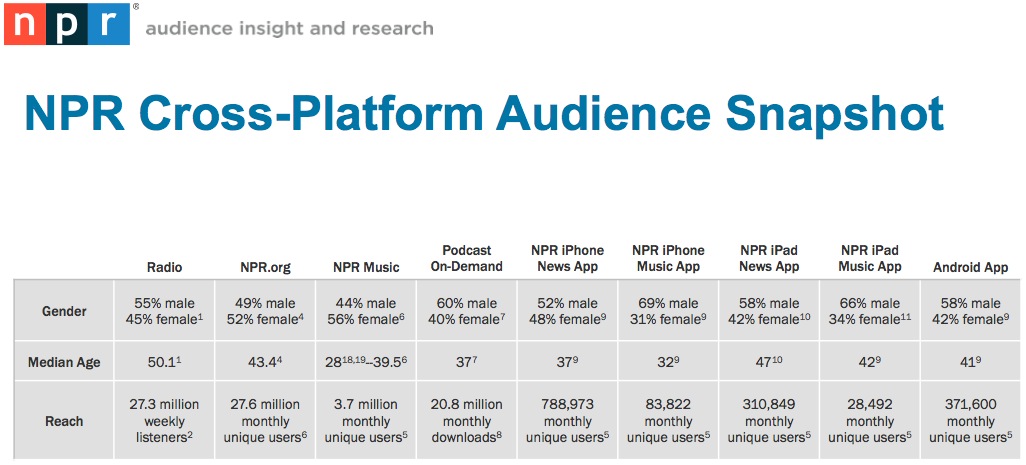
As it turns out, I’m not alone–people love streaming, as evidenced on NPR’s Cross-Platform Audience Snapshot. Something I noticed right away (and was pointed out in Poynter’s article, “NPR One App Potential is Huge“) is the similarity between the app and Pandora. Both are simple, personalized, portable, and push listeners into new genres or beats.

History in the making: My first NPR One article
Play is an accurate verb, because I found that browsing the app was a genuinely fun experience. Different sections of the app were very easy to navigate, and I felt like I was able to glide from story-to-story with ease. As I first logged on, Michigan Radio was suggested as my local public radio station, a taste of the personalization that was to come. I will admit, I was a little creeped-out at first (how did they know my life?) Quickly, I got over this.
My first story was “High School Reconsiders Student’s Yearbook Photo.” Immediately, I wished there were text to accompany the story (or at least a picture to help me visualize the yearbook photo). Soon after, however, I realized that accompanying stories with text would defeat the purpose of the app, which seems to be providing tailored radio stories to accompany our daily lives on-the-go. As I grew increasingly familiar with the app, I missed the text less and less.

A story tailored for me that I labeled “interesting”
For me, the primary advantage of NPR One is its suggestions, living up to its slogan, “Public Radio Made Personal.” I tapped into the search section expecting to seek out specific content; instead, the suggestions list in this section introduced me to articles that mainly related to my interests, but that I wouldn’t have otherwise sought out, leading me in a pleasantly unexpected direction. Some suggestions I received in the Search section were articles relating to Michigan, higher education, and music, three of my interests. Something I always thought online news lacked was the “stumble-upon” factor, where I am introduced to an article without having to actively seek out the content. NPR fulfills this and goes a step further to present content relevant to an individual’s interests. For example, when streaming, I was directed to Michigan Radio’s “Classic rock born in Michigan almost 30 years ago,” which I might not have clicked on had it been online but listened to because it was next on my stream. As it turned out, the story was relevant and thought-provoking. Forcing me out of my comfort zone had worked–go figure!

Suggestions tailor to my interests and my local station whilst introducing me to new beats
Still, considering that the app is in its early stages, I’m expecting a few changes in the future. One thing I hope to see is the ability to save or bookmark stories. This might already be an option that I’m not aware of, but I think it would be convenient to be able to reference certain stories later on. I suppose this could be achieved through the app’s sharing function, as sharing options for social media and other platforms are readily available for each article, but a list under the “Account” section could be useful.

Options for sharing are convenient for each story
Probably my most-missed element of classic NPR, however important it may be to other listeners, was the station’s iconic musical interludes. Sure, these may not be deemed completely necessary to the journalistic value of the content–but if we didn’t hear that faithful, staccato All Things Considered theme before the story, can we claim that everything was really considered?
Pickiness aside, I was definitely pleased with NPR One. Will it change the future of mobile radio journalism, as NeimanLab is predicting? We’ll have to see. All I know for sure is that I will definitely keep listening.
Being a recently declared Communications major, I decided to live-tweet U of M’s first-annual Communications Studies Fall Convocation. The event provided students with an opportunity to learn more about the program, hear from a Michigan Communications alum, and network with faculty and peers. In my first tweet, I attempted to generate a little more attention by mentioning the Communications Studies’s Twitter handle:
Being that convocations are a historically “dry” type of event, I tried to spice it up a little by including pictures and the (what I thought was catchy) hashtag, #commvocation. The following tweet garnered the most attention, even though it was only one retweet and two favorites. Though it wasn’t exactly hard-hitting news, I told the people what they needed to hear:
Then I attempted to describe the scene, however relevant the information may have been:
I tried to include notable quotes from speakers; this was more difficult than I thought it would be, as I didn’t want to look disrespectful by having my phone out during the presentation.
When guest speaker Val Boreland was introduced, she conveniently shared her Twitter handle with the group–I took this as my cue to give her a mention:
Tied for my most favorited/retweeted tweet included a mention to Val Boreland. It makes sense that this was favorited and retweeted by Boreland, which was great; however, looking back, I realize that only those following Boreland saw the tweet, since I didn’t include a “.” before linking to her Twitter handle:
Again, attempting to give the audience a sense of the surroundings at convocation, as well as a sense of what was on everyone’s mind:
Looking back. I could have put more effort into my pictures, as this one is pretty blurry. Still, I think they work to set the scene and catch the audience’s attention:
Here, instead of having the subject pose for a photo, I would’ve captured a more candid shot; but with the strangely-fitting “Go-Getter” Diet Coke can, I couldn’t resist the (albeit cheesy) photo opportunity:
Overall, I’d say my live-tweeting experience went rather smoothly and attracted a fair amount of attention, especially considering that I only have 17 Twitter followers. For now, I’ll try to get that number up and keep tweeting!